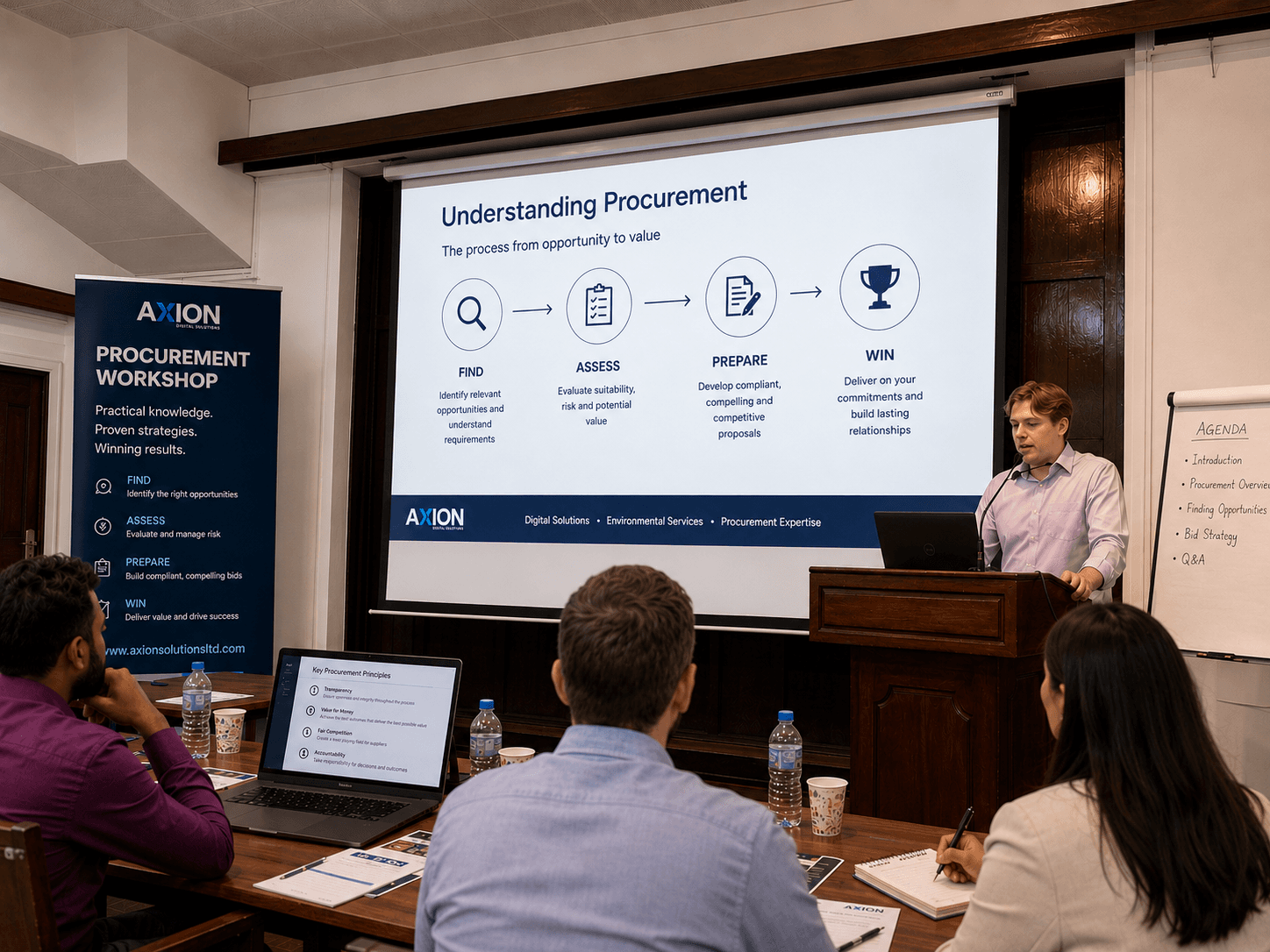
A new era for UK public procurement
The Procurement Act 2023 is now the main legal framework governing public procurement in England, Wales and Northern Ireland. It came into force on 24 February 2025, replacing much of the previous EU-derived procurement regime with a UK-specific system intended to make public procurement simpler, more transparent and more accessible to suppliers.
For contracting authorities, the Act changes how procurements are planned, advertised, assessed, awarded and managed. For suppliers, particularly SMEs, voluntary sector organisations and new market entrants, it is designed to reduce unnecessary barriers and make public contract opportunities easier to find and compete for.
The scale of the opportunity is significant. Public procurement represents hundreds of billions of pounds of annual public sector spending, with the Local Government Association citing approximately £385 billion spent each year on essential goods and services. The Act therefore matters not only as a compliance exercise, but as a major reform to how public money is used to deliver services, infrastructure and innovation.
Why was the Procurement Act introduced?
The Procurement Act 2023 was introduced following the UK’s departure from the EU, giving government the opportunity to consolidate and reform the previous procurement rules. The policy aim is to create a regime that is quicker, more flexible, more transparent and better aligned with UK public policy objectives.
The Cabinet Office describes the reforms as part of the wider “Transforming Public Procurement” programme. The official guidance explains that the new regime is intended to help procurement practitioners and commercial policy leads understand and apply the Act and its associated regulations.
In practical terms, the Act seeks to address long-standing concerns from both buyers and suppliers, including:
- overly complex tender processes;
- repeated supplier information requests;
- limited visibility of opportunities before formal tender publication;
- inconsistent feedback and award information;
- barriers faced by SMEs and voluntary, community and social enterprise organisations;
- fragmented procurement data across multiple systems;
- insufficient transparency across the full contract lifecycle.
The reform is therefore not simply about changing the rules at the point of tender. It is about improving the entire procurement lifecycle, from early market engagement and pipeline planning through to contract performance, modification and termination.
The Central Digital Platform: a major change for suppliers and buyers
One of the most important reforms is the Central Digital Platform, now centred on Find a Tender. The Cabinet Office guidance explains that Find a Tender is where UK contracting authorities publish procurement information, where identifiers are recorded or issued, and where suppliers input commonly used information.
This is a major operational shift. Under the new regime, suppliers can provide core business information once and then re-use it across multiple procurements. For SMEs, this is especially important because repetitive selection questionnaires and administrative duplication have historically created disproportionate burdens.
For contracting authorities, the platform is central to transparency and compliance. Procurement notices, supplier information and procurement records are increasingly expected to flow through a more standardised digital process. The Cabinet Office guidance on the Central Digital Platform covers publication requirements, supplier information and record-keeping obligations.
The direction of travel is clear: public procurement is becoming more data-driven, more visible and more standardised. Buyers that still manage procurement as a largely manual document-based process will need to modernise their internal controls, workflows and audit trails.
Transparency across the procurement lifecycle
The Procurement Act places a much stronger emphasis on transparency. This is one of its defining features.
Under the new rules, transparency is not limited to the publication of a contract notice and contract award notice. Instead, the regime introduces publication requirements across more stages of the procurement and contract lifecycle. These include planning, tendering, award, contract management and, in some cases, contract performance.
The government has described these as new transparency requirements introduced at the launch of the Act in February 2025, with further elements being commenced as part of the phased rollout of the Transforming Public Procurement Programme.
For public bodies, this means procurement teams must think about disclosure from the outset. They need to understand what must be published, when it must be published, and what information may legitimately be withheld, for example for confidentiality, security or commercial sensitivity reasons.
For suppliers, increased transparency should provide greater visibility of opportunities, award decisions and public sector buying behaviour. Over time, this should make it easier for suppliers to identify relevant markets, understand buyer priorities and make more informed bid/no-bid decisions.
The National Procurement Policy Statement
The National Procurement Policy Statement, or NPPS, sits alongside the Procurement Act and sets out strategic priorities for public procurement. The government states that the NPPS came into effect on 24 February 2025 alongside the Act and remains in place until withdrawn, amended or replaced.
The NPPS matters because procurement is no longer seen purely as a transactional purchasing function. Public bodies are expected to consider how procurement can support wider outcomes, including value for money, resilience, innovation, growth, social value and effective delivery.
For contracting authorities, this means procurement strategies should be aligned with organisational objectives and public policy priorities. For suppliers, it means that strong bids increasingly need to demonstrate more than technical compliance and price competitiveness. They need to show credible delivery, risk management, measurable outcomes and an understanding of the buyer’s wider objectives.
What has changed for contracting authorities?
For public sector buyers, the Procurement Act creates both opportunities and responsibilities.
The most immediate change is the need to operate under a new statutory framework, supported by Cabinet Office guidance and associated regulations. Procurement teams must ensure that templates, procedures, evaluation models, governance arrangements and publication workflows reflect the new regime.
Key changes for contracting authorities include:
1. More flexible procurement procedures
The Act is intended to simplify the previous procurement procedure landscape. Buyers have more flexibility to design competitive processes that are proportionate to the requirement, provided they comply with the Act’s principles and transparency obligations.
This should support more intelligent procurement design, particularly for complex services, innovation, technology, consultancy, research and transformation projects where rigid procedures can limit market engagement and solution development.
2. Stronger planning and pipeline visibility
The Act encourages greater transparency before formal procurement begins. Buyers will need to be more disciplined about forward planning, pipeline publication and early market engagement.
This is beneficial when done properly. Better early engagement can improve specifications, reduce procurement failure, increase competition and give SMEs more time to prepare.
3. Greater scrutiny of supplier performance and exclusion grounds
The Act includes a stronger framework for considering supplier integrity, performance and exclusion. Buyers will need to apply these rules carefully and consistently, ensuring that decisions are evidenced and proportionate.
For high-risk or mission-critical contracts, this creates a stronger basis for assessing supplier reliability, not just price.
4. More publication and record-keeping obligations
The new regime requires authorities to maintain stronger records and publish more information through the Central Digital Platform. This means procurement teams need robust internal systems and clear accountability for notice publication, audit trails and document retention.
5. A stronger focus on removing barriers to SME participation
The Act and wider policy environment place clear emphasis on improving access for SMEs and new entrants. Buyers should avoid unnecessary requirements, excessive insurance thresholds, disproportionate turnover tests and over-complex tender documentation where these are not justified by the contract.
This is particularly relevant for below-threshold and local procurement, where proportionate processes can significantly increase supplier participation.
What has changed for suppliers?
For suppliers, the Procurement Act creates a more transparent but also more competitive environment.
The most positive change is that opportunities should become easier to find and supplier information should become easier to reuse through the Central Digital Platform. This should reduce some of the administrative burden associated with bidding for public contracts.
However, suppliers should not assume that the new regime makes bidding easy. Public sector procurement remains evidence-led, compliance-heavy and competitive. Suppliers still need strong method statements, clear case studies, robust pricing, relevant policies, and a professional approach to quality assurance and contract delivery.
Key supplier implications include:
1. Better opportunity visibility
More notices and procurement information should make it easier to understand what buyers are planning, what they are buying and when opportunities are likely to come to market.
This gives proactive suppliers a commercial advantage. Businesses that monitor pipelines, early engagement notices and market signals will be better placed than those waiting for fully formed tender opportunities.
2. Reusable supplier information
The Central Digital Platform is designed to reduce duplication by allowing suppliers to input commonly used information. This is particularly helpful for SMEs that do not have large bid teams.
However, suppliers still need to ensure that their information is accurate, complete and up to date. Poorly maintained supplier profiles may create avoidable compliance risks.
3. More emphasis on evidence and performance
As procurement becomes more transparent and data-led, suppliers will need to demonstrate credible experience, measurable outcomes and reliable delivery. Generic claims will be less persuasive than specific, evidenced examples.
Case studies, client references, performance metrics and clear delivery methodologies will remain central to successful bidding.
4. Stronger need for bid/no-bid discipline
Greater visibility of public opportunities can be a double-edged sword. Suppliers may see more tenders, but not every tender will be worth pursuing.
The most successful suppliers will use structured bid/no-bid assessment, considering buyer fit, contract value, evaluation criteria, incumbent position, evidence requirements, pricing risk and delivery capability.
What does the Act mean for SMEs?
The Procurement Act is particularly relevant to SMEs because it aims to make public procurement more accessible to smaller businesses and new entrants.
The previous regime was often criticised for creating unnecessary complexity. SMEs frequently faced barriers such as excessive documentation, high insurance requirements, disproportionate financial thresholds and limited visibility of upcoming opportunities.
The new regime seeks to reduce these barriers through simpler processes, greater transparency and improved supplier information management. The government and public sector bodies have also placed strong emphasis on making procurement more accessible to small businesses and voluntary sector organisations.
For SMEs, the opportunity is real, but it requires preparation. Businesses that want to win public contracts should ensure they have:
- clear service descriptions;
- concise and credible case studies;
- up-to-date insurance and policy documents;
- strong financial and legal information;
- a professional bid library;
- evidence of social value and responsible business practices;
- a process for tracking opportunities and deadlines.
The Act may reduce friction, but it will not remove the need for quality, compliance and professionalism.
Below-threshold procurement: why it matters
A significant volume of public sector purchasing takes place below the main procurement thresholds. This is especially important for SMEs, local suppliers, charities, consultants and specialist service providers.
The Procurement Act reinforces the importance of proportionate procurement and transparency, even where contracts fall below the full regime thresholds. Contracting authorities should still be able to justify their approach, avoid unnecessary barriers and maintain fair, transparent processes.
For suppliers, below-threshold procurement can be a practical route into public sector work. These opportunities are often more accessible than large framework procurements, but they still require speed, responsiveness and credible evidence.
For buyers, below-threshold procurement is an opportunity to engage a more diverse supply base, encourage local economic participation and deliver value without imposing disproportionate bureaucracy.
The importance of procurement data
One of the less discussed but highly significant consequences of the Procurement Act is the growing importance of procurement data.
As more notices, identifiers and supplier information move through the Central Digital Platform, procurement data should become more structured and more useful. Over time, this can support better spend analysis, supplier market intelligence, transparency reporting, social value monitoring and contract management.
For contracting authorities, this creates an opportunity to move away from fragmented spreadsheets and manual trackers. Good procurement data can help answer important questions, such as:
- Which suppliers are winning contracts?
- How much spend is going to SMEs?
- Where are procurement processes taking too long?
- Which markets have low competition?
- Which contracts are being modified after award?
- Are social value and performance commitments being tracked?
- Are local or regional suppliers engaging with opportunities?
For suppliers, better data can support smarter business development. It can help identify active buyers, relevant contract pipelines, incumbent suppliers, renewal dates and market gaps.
The Act therefore supports a more intelligence-led procurement environment, where both buyers and suppliers can make better decisions.
Practical steps for contracting authorities
Contracting authorities should treat the Procurement Act as both a compliance requirement and a transformation opportunity.
A practical readiness checklist should include:
- Review procurement policies, templates and internal guidance against the Act and Cabinet Office guidance.
- Ensure staff understand the Central Digital Platform and publication requirements.
- Map the full procurement lifecycle from planning to contract termination.
- Update internal approval processes and governance controls.
- Review standard selection and award criteria for proportionality.
- Remove unnecessary barriers for SMEs and VCSE suppliers.
- Improve early market engagement and pipeline planning.
- Strengthen record-keeping and audit trails.
- Train budget holders and service leads, not only procurement staff.
- Review contract management processes, including performance monitoring and modification controls.
The authorities that benefit most from the Act will be those that use it to improve procurement maturity, not those that treat it as a narrow legal update.
Practical steps for suppliers
Suppliers should also take active steps to adapt.
A supplier readiness checklist should include:
- Register and maintain information on Find a Tender / the Central Digital Platform.
- Prepare standard company information, policies and declarations.
- Build a bid library with strong, tailored case studies.
- Track early engagement and pipeline notices, not just live tenders.
- Develop a structured bid/no-bid process.
- Understand how buyers evaluate quality, price, risk and social value.
- Keep evidence of delivery outcomes, client feedback and performance metrics.
- Review insurance, accounts and compliance documents before bidding.
- Monitor frameworks, DPS opportunities and below-threshold contracts.
- Invest in professional bid writing and contract management capability.
The suppliers that succeed under the new regime will be those that combine opportunity tracking with disciplined bidding and strong evidence.
Common risks and misconceptions
Although the Procurement Act is designed to simplify procurement, it does not remove complexity entirely.
A few misconceptions should be avoided.
First, the Act does not mean public bodies can award contracts informally without proper process. Transparency, fairness, proportionality and record-keeping remain essential.
Second, the Act does not mean SMEs will automatically win more contracts. It should improve access, but suppliers still need to compete effectively.
Third, the Central Digital Platform does not remove the need for tailored tender responses. Standard supplier information helps with administration, but buyers will still evaluate specific proposals against specific requirements.
Fourth, transparency does not mean every piece of information will be published without exception. Authorities still need to consider confidentiality, security and commercial sensitivity, but any withholding of information must be handled carefully and lawfully.
Finally, compliance with the Act is not just a procurement department issue. Service teams, finance teams, legal teams, contract managers and senior decision-makers all have a role to play.
What should organisations do now?
The Procurement Act 2023 is now operational. Organisations should therefore move beyond awareness and into practical implementation.
For contracting authorities, the priority should be embedding the new regime into everyday procurement practice. That means updating documents, training teams, strengthening governance and using the Central Digital Platform properly.
For suppliers, the priority should be readiness and market positioning. Businesses should ensure that they are visible, compliant and able to respond quickly to suitable opportunities.
For both sides, the Act presents a chance to improve how procurement works. Done well, it should support better competition, better data, better market engagement and better public outcomes.
Conclusion
The Procurement Act 2023 represents one of the most significant reforms to UK public procurement in a generation. It introduces a new framework built around flexibility, transparency, digitalisation and improved access for suppliers.
The Act is not just a legal change. It is a practical shift in how public contracts are planned, advertised, competed, awarded and managed. Buyers will need stronger systems and clearer governance. Suppliers will need better evidence, sharper bidding discipline and a more proactive approach to opportunity tracking.
For SMEs and new entrants, the reforms should create a more accessible market. For public bodies, they provide an opportunity to modernise procurement and deliver better value from public spending.
The organisations that respond early and seriously will be best placed to benefit from the new regime.
References
Cabinet Office. (2025) Transforming Public Procurement. GOV.UK. Available at: https://www.gov.uk/government/collections/transforming-public-procurement .
Cabinet Office. (2025) Procurement Act 2023: guidance documents. GOV.UK. Available at: https://www.gov.uk/government/collections/procurement-act-2023-guidance-documents .
Cabinet Office. (2025) National Procurement Policy Statement. GOV.UK. Available at: https://www.gov.uk/government/publications/national-procurement-policy-statement .
HM Government. (2023) Procurement Act 2023, c.54. UK Public General Acts. Available at: https://www.legislation.gov.uk/ukpga/2023/54/contents .