Executive Summary
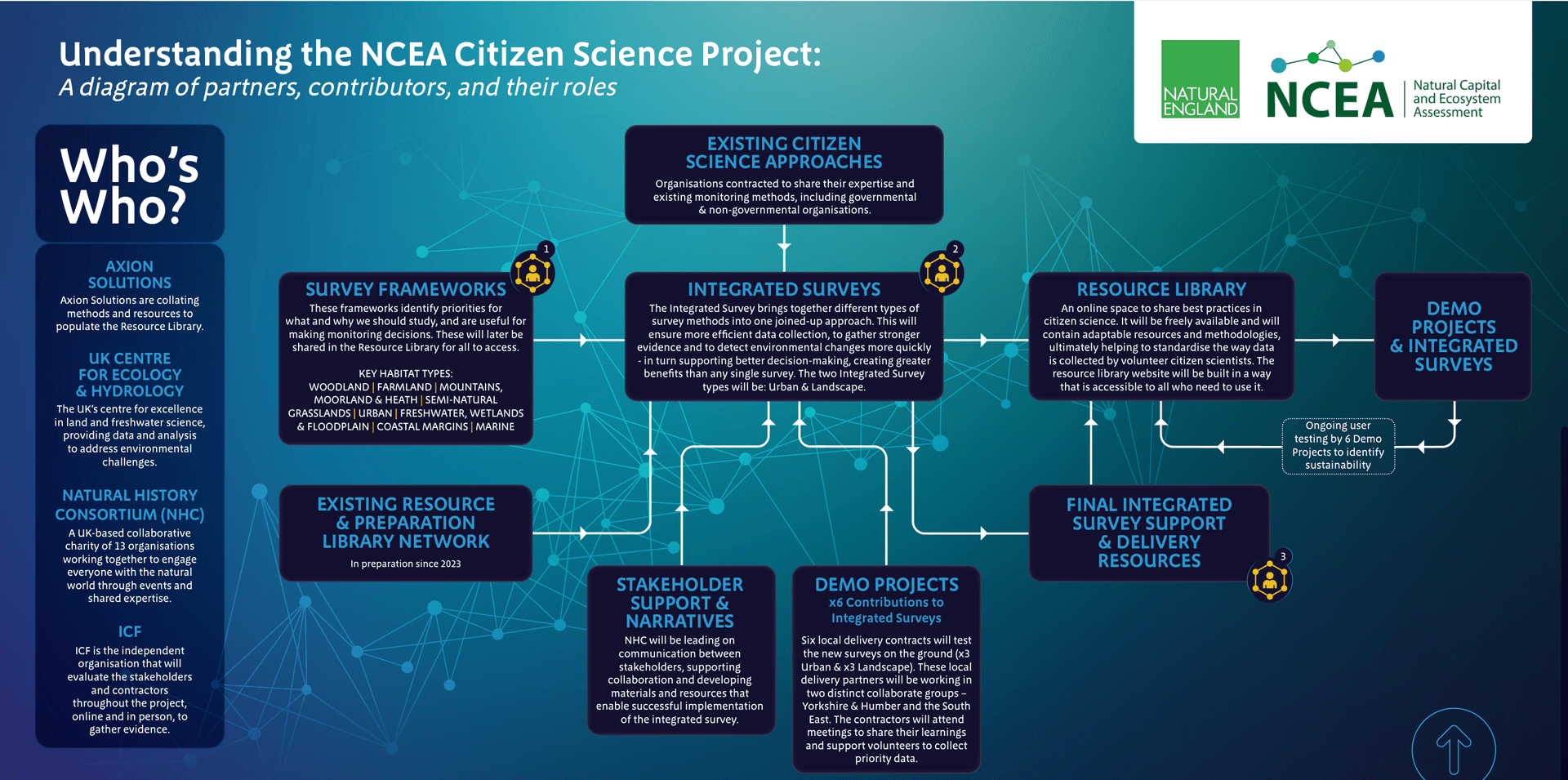
Axion Solutions was commissioned by Natural England to deliver a cornerstone contract within the Natural Capital and Ecosystems Assessment (NCEA) programme: the development of resources, frameworks, and digital infrastructure to transform how citizen science is coordinated, supported, and mobilised across England. The commission addressed a long-recognised systemic challenge: while citizen science already underpins much of the UK’s biodiversity evidence base, effort is fragmented, resources are duplicated, data pathways are inconsistent, and volunteers often lack clarity on how their contributions inform national decision-making. Axion delivered a step-change intervention, combining:
- National and habitat-specific Survey Frameworks
- A structured Resource Library content system
- Extensive stakeholder co-design (16 national and local workshops)
- A bespoke interactive digital framework enabling navigation, sense-making and adoption
The result is a coherent, scalable citizen science infrastructure that supports evidence quality, volunteer empowerment, and long-term policy relevance.
Strategic and Policy Context
The Natural Capital and Ecosystems Assessment (NCEA) programme is a flagship Defra initiative, designed to transform how evidence on England’s natural assets is captured, analysed, and used in decision-making. Citizen science is a critical pillar of this ambition. Volunteer-led monitoring
- Generates data at scales and resolutions not achievable by professional surveys alone
- Supports long-term trend analysis
- Deepens public connection to nature
- Provides essential coverage across habitats and geographies
However, prior to this commission, citizen science activity suffered from:
- Fragmentation across organisations and geographies
- Inconsistent methodologies and data standards
- Limited visibility of priorities
- Weak feedback loops for participants
Natural England therefore required a delivery partner capable of system design, stakeholder facilitation, analytical synthesis, and digital translation not simply content production.
The Challenge: Fragmented Activity to National Citizen Science Infrastructure
The commission addressed a challenge that has been widely recognised across Defra group bodies, but rarely tackled in a systematic way: citizen science delivers enormous value to environmental evidence, yet operates without a shared national infrastructure to coordinate effort, standards, and purpose. This was not a gap that could be resolved through guidance alone. It required the design of a system that could operate across organisations, habitats, and scales, while remaining accessible to volunteers and practical for delivery bodies.
Fragmentation across a complex delivery landscape
Citizen science activity in England spans:
- National NGOs
- Local environmental organisations
- Volunteer networks
- Academic institutions
- Statutory bodies
- Informal community groups
Each operates with different:
- Objectives
- Capacities
- Data standards
- Funding cycles
- Digital tools
While this diversity is a strength, in the absence of coordination it leads to:
- Duplication of effort
- Inconsistent data quaity
- Gaps in coverage for priority habitats and pressures
- Limited interoperability between datasets
Natural England required a delivery partner capable of seeing across this landscape, identifying common structure without flattening diversity.
A core challenge was the absence of shared narratives connecting monitoring questions, survey methods, volunteer effort, national natural capital priorities, and data mobiliation into policy. In many cases, citizen scientists contribute data without clarity on why it is being collected, how it is being used, what decisions it informs, and whether it fills an evidence gap or duplicates existing data. This disconnect often risks volunteer disengagement, misalignment with policy needs, and inefficient use of limited capacity. The commission therfore required the development of logic-chain-based frameworks that could explicitly link participation to decision-making.
Other challenges include:
- Tension between scientigic rigour and inclusive participation
- Capacity constraits across the sector
- Static outputs versus living systems
- Digital translation as a critical success factor
Why this challenge required Axion
Taken together, these challenges meant the commission required a delivery partner able to operate across:
- Environmental science
- Natural capital accounting
- Stakeholder co-design
- Systems thinking
- Digital framework development
Axion's role was to turn complexity into structure without oversimplification -- and to do so in a way that would endure beyond the life of the contract.
ACER's Research-Led Approach: Designing a Living National System
Axion approached the NCEA commission as a system-design challenge, not a content delivery exercise. The methodology was explicitly designed to move citizen science from fragmented activity toward a coherent, living national infrastructure that could be stewarded, adapted, and scaled over time. Rather than separating analysis, engagement, and digital development into sequential phases, Axion adopted an integrated, iterative methodology, ensuring that insights from one strand continuously informed the others.
Methodological principles
Five core principles guided delivery throughout the contract:
- Systems before outputs: Every output was designed as part of a wider system of priorities, actors, data flows, and decision points.
- Co-design as a delivery mechanism, not consultation: Stakeholders were engaged as contributors to system design, not reviewers of pre-defined solutions.
- Transparency of logic: Frameworks explicitly set out why priorities exist, how methods connect to them, and where gaps remain.
- Usability at multiple levels: Outputs needed to work for national policy teams, local practitioners, and volunteers alike.
- Future stewardship built in: The methodology ensured outputs could be reviewed, updated, and governed beyond the life of the contract.
Frameworks
Structuring national monitoring around evidence need
At the core of the programme are a suite of habitat-based Survey Frameworks. These frameworks provide a consistent national architecture linking:
- Natural capital priorities
- Monitoring questions
- Survey approaches (including citizen science)
- Data pathways into policy and decision-making
Rather than cataloguing existing surveys, the frameworks articulate a clear logic chain:
Why we monitor → What we need to know → How evidence is generated → How it informs decisions.
A consistent, scalable structure
Axion applied a shared architecture across all habitats, ensuring comparability while retaining ecological specificity. In addition to refining existing frameworks, five new broad habitat frameworks were developed:
- Semi-natural grasslands
- Mountains, moorlands and heath
- Coastal margins
- Woodlands
- Enclosed farmland
Each framework:
- Identifies priority monitoring questions
- Clarifies where citizen science adds greatest value
- Avoids duplication with professional surveys
- Aligns local activity with national policy needs
Sixteen structured national and local workshops ensured the frameworks were co-designed with policy teams, practitioners, and delivery organisations — building shared ownership and implementation readiness.
From documentation to living system
Critically, the frameworks were not designed as static reports. They are:
- Structured for annual review
- Compatible with evolving monitoring priorities
- Integrated into a wider digital interface
- Designed for stewardship beyond the contract period
The result is a decision-support system, not simply guidance.
Resource Library
Building shared infrastructure for quality and scale
Alongside the frameworks, Axion designed a national Resource Library — not as a repository, but as infrastructure.
Previously, high-quality citizen science tools and guidance were dispersed across organisations, inconsistently described, and difficult to reuse. This led to duplicated effort and variable data quality.
The Resource Library addresses this by:
- Aligning all resources to Survey Framework priorities
- Standardising templates and metadata
- Defining inclusion criteria based on evidence need and quality
- Creating clear governance and permissions processes
Structured around the project lifecycle
The Library is organised to support the full lifecycle of a citizen science project, including:
- Defining purpose and objectives
- Survey design and methodology
- Data collection and quality assurance
- Volunteer recruitment and inclusivity
- Health, safety and delivery
- Evaluation and feedback
This enables organisations to assemble robust, policy-aligned projects using proven materials — reducing friction and avoiding reinvention.
Platform-ready and future-proof
Axion delivered:
- A complete Library architecture
- Standardised templates
- A prioritised resource list
- Developed content ready for platform integration
- A roadmap for expansion and review
The Library functions as a coordination mechanism — raising overall quality, improving interoperability, and ensuring volunteer effort contributes directly to identified evidence gaps.
Impact and Legacy
The project has delivered:
- A nationally coherent citizen science architecture
- Clear alignment between participation and policy
- Reduced duplication across the sector
- Improved data quality and interoperability
- Greater transparency for volunteers
- Scalable digital infrastructure for long-term stewardship
Citizen science within the NCEA programme is now positioned not as a supplementary activity, but as structured national infrastructure — capable of being coordinated, reviewed, and expanded over time.
This commission demonstrates that when participation, evidence design, and digital infrastructure are developed together, citizen science becomes a strategic capability.
Axion’s role extended beyond content delivery to full system design — integrating analytical rigour, co-design, governance, and digital translation into a durable national asset for environmental monitoring in England.
Project Gallery