Executive Summary
Under the Ocean Country Partnership Programme (OCPP), the Centre for Environment, Fisheries and Aquaculture Science (Cefas) commissioned Axion to design and deliver a structured underwater passive acoustic monitoring (PAM) training programme in Sri Lanka.
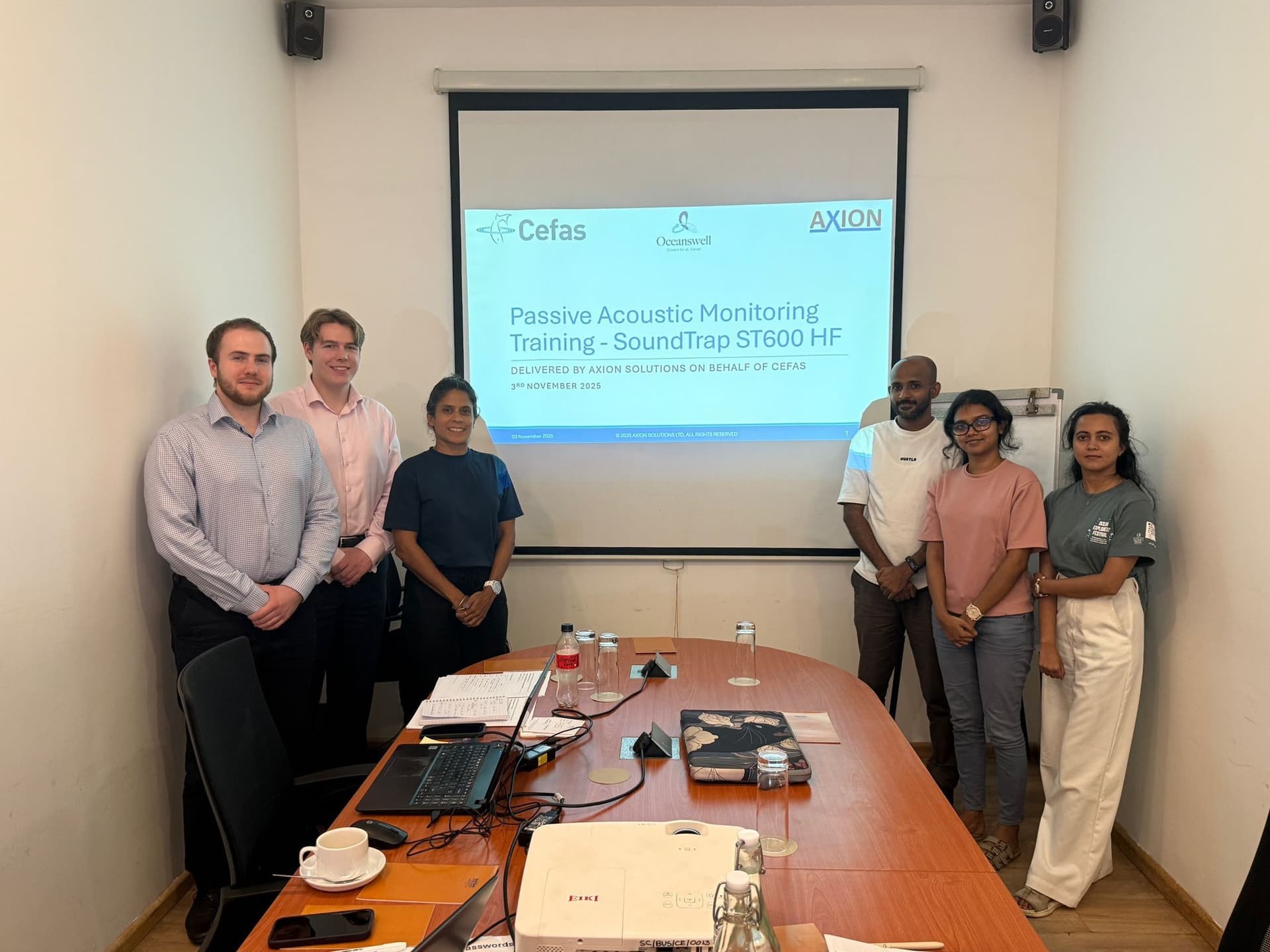
Delivered in Colombo and at the Kalpitiya field site, the programme focused on building national capacity to independently deploy and manage SoundTrap ST600 HF long-term recorders for marine biodiversity monitoring.
The objective was clear: move from equipment provision to sustainable, operational national capability aligned with international best practice.
From Training to Operational Autonomy
Sri Lanka’s marine waters are biodiverse and strategically significant, yet long-term acoustic monitoring had been limited by gaps in specialist equipment handling, deployment protocols, and structured data governance.
Axion designed a systems-based capacity-building intervention combining:
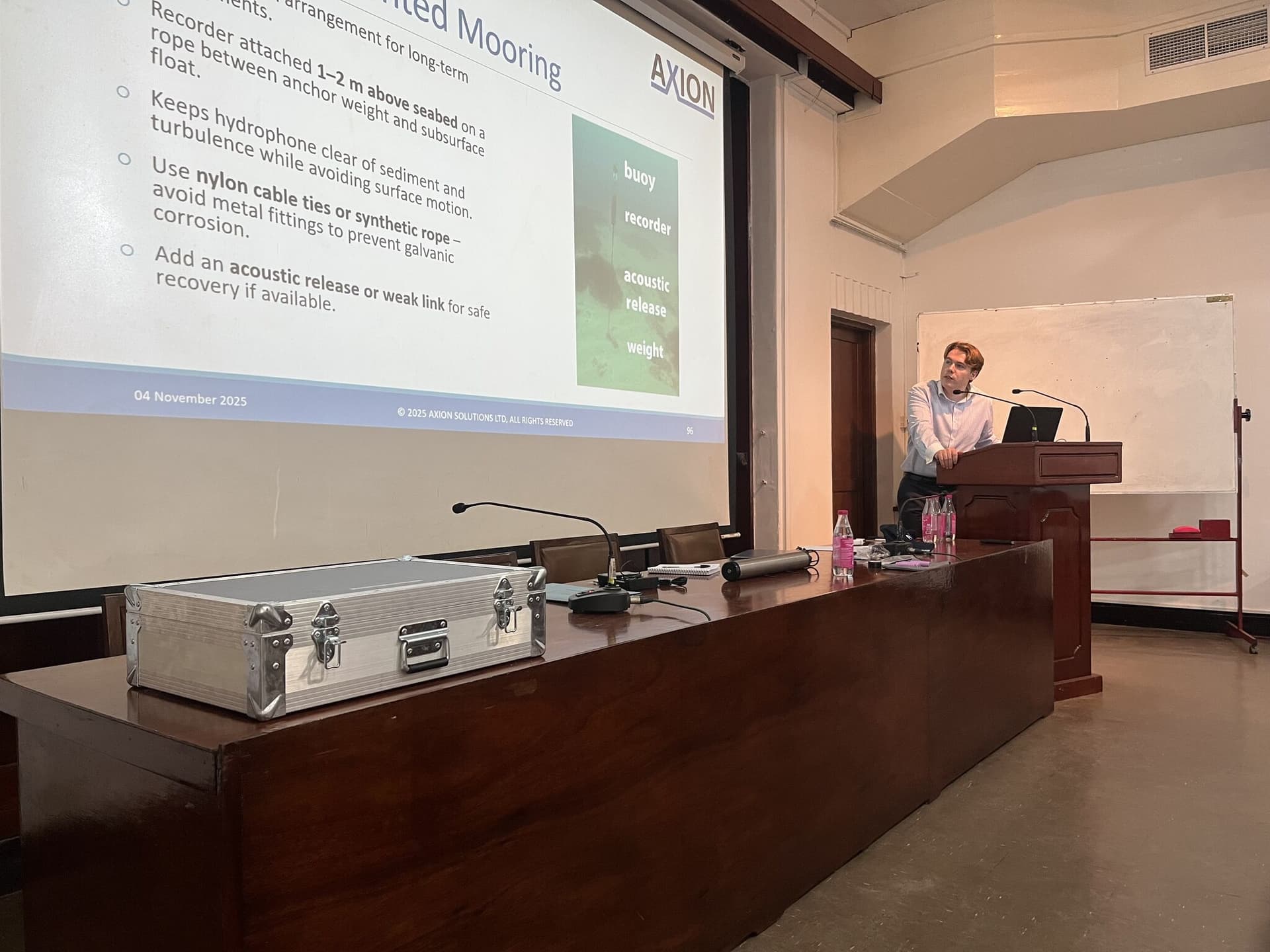
- Classroom-based foundations in underwater acoustics
- Practical field deployment and retrieval training
- Data processing and spectrogram interpretation
- Equipment maintenance and QA protocols
- Structured manuals, templates, and technical documentation
Over 30 participants from government agencies and NGOs were trained, with a strong emphasis on transitioning from theoretical understanding to confident marine-operational execution.
Field-Based Learning at Kalpitiya
Kalpitiya was selected as a realistic but manageable acoustic training environment, offering mixed biological and anthropogenic sound conditions.
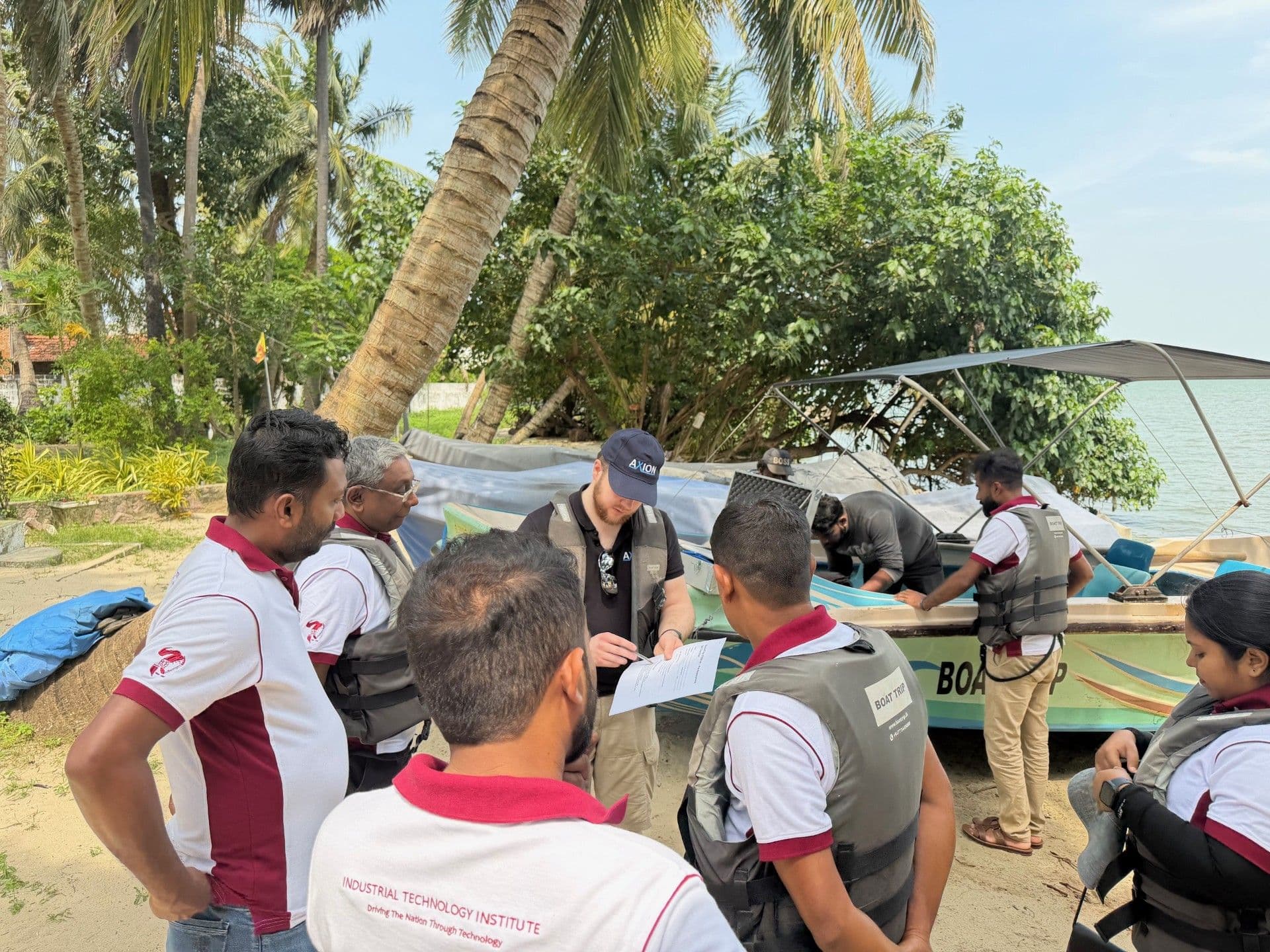
Participants undertook repeated deployment cycles, including:
- Mooring assembly and configuration
- Vessel-based deployment and retrieval
- Post-recovery inspection and maintenance
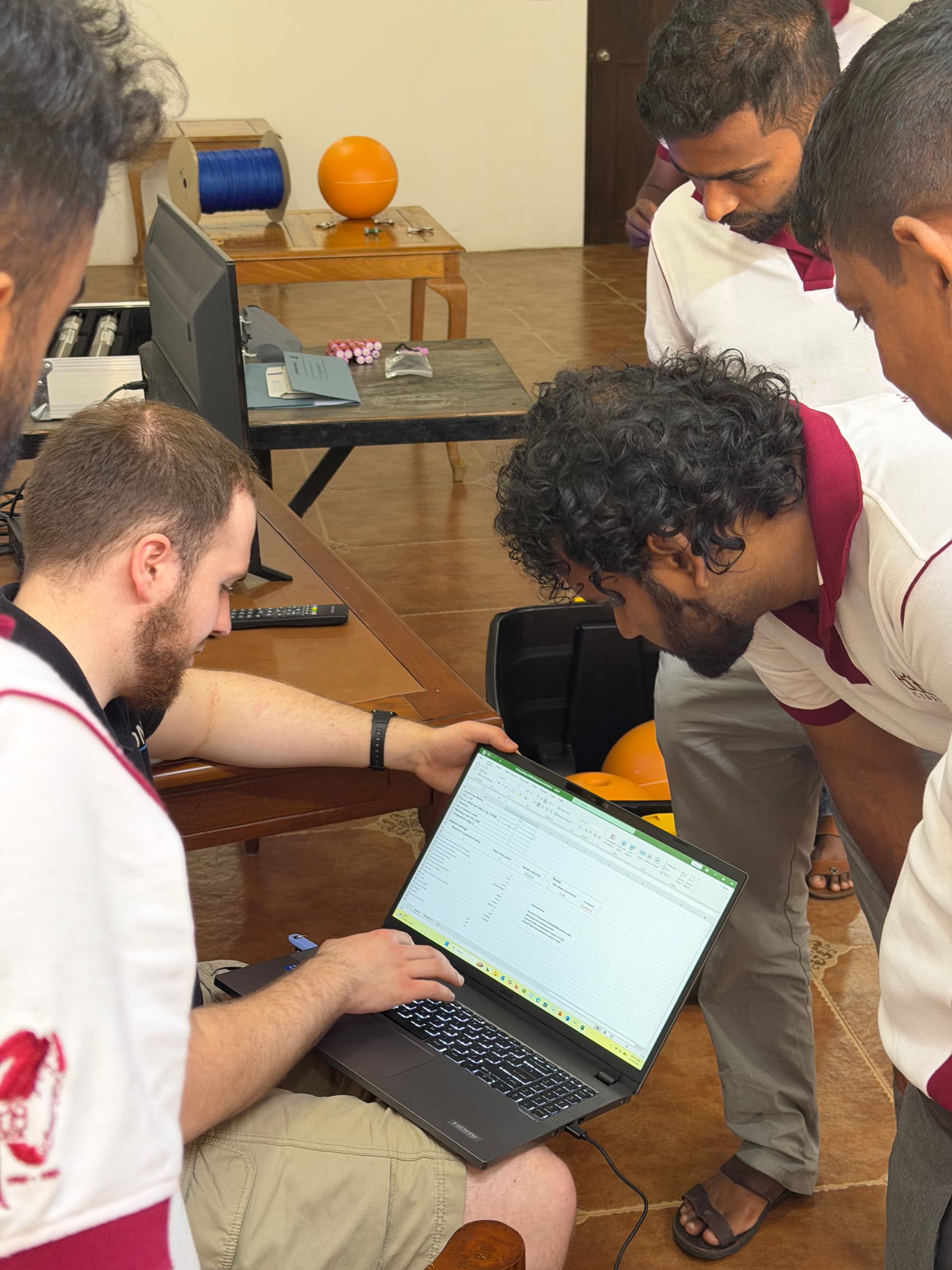
- Data download and structured storage
- Spectrogram-based signal interpretation
Iterative field exercises allowed participants to refine handling techniques, improve retrieval efficiency, and strengthen quality assurance discipline.
Crucially, trainees successfully linked real-world field conditions to acoustic outputs — identifying vessel pass-bys, broadband anthropogenic noise, and ambient variability.
Embedding Sustainable Systems
To ensure long-term impact beyond the in-country training period, Axion transferred a comprehensive operational resource package to national partners, including:
- Deployment checklists and QA templates
- Maintenance and calibration procedures
- Data management workflows
- PAMGuard-based review guidance
- Risk assessment and safety briefing templates
This documentation ensures monitoring protocols are reproducible, auditable, and transferable to additional staff.
Inclusive delivery principles were embedded throughout, aligning with OCPP safeguarding and GEDSI requirements.
Capability Outcome and Strategic Value
By programme completion, participants demonstrated:
- Independent execution of full deployment cycles
- Safe marine operational practice
- Structured data governance and QA discipline
- Applied acoustic interpretation skills
Sri Lanka now has a technically competent acoustic monitoring nucleus, supported by documented systems and transferable training materials.
The intervention establishes the foundation for:
- Long-term national acoustic baselining
- Monitoring anthropogenic marine noise
- Integration with biodiversity research
- Contribution to regional and international marine evidence systems
This programme demonstrates Axion’s ability to design and deliver practical, durable marine science capacity-building — embedding not just knowledge, but operational autonomy.
Project Gallery