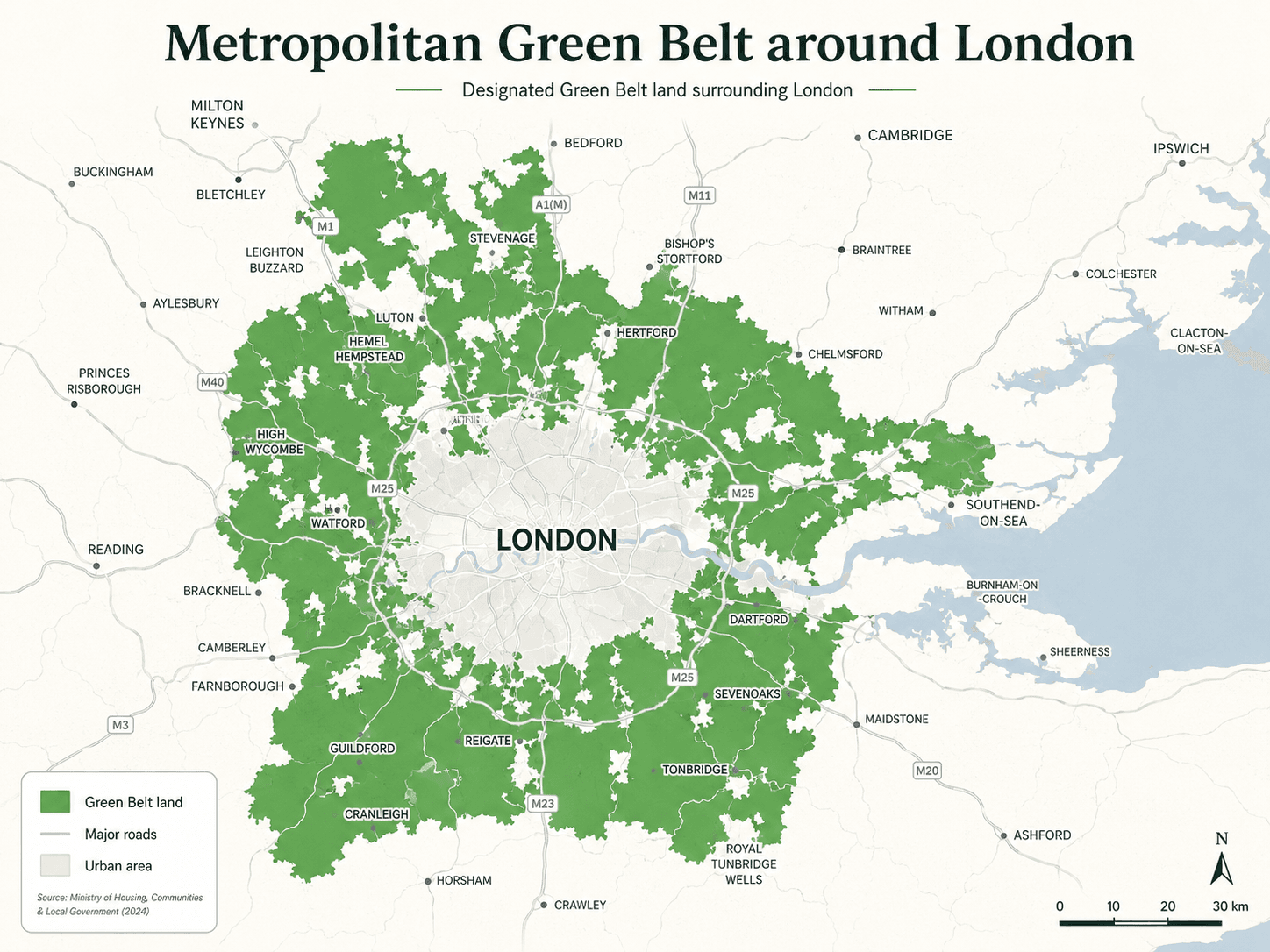
Green Belt Under Pressure: Why Development, Planning Reform and Local Politics Are Changing the Debate
Green Belt land has always sat at the centre of one of England’s hardest planning questions: how do we protect countryside and open space while also building the homes, infrastructure and services that communities need? That question is becoming more urgent. Recent planning reforms, housing targets and shifting local election results are changing the balance of power between national policy, local councils, developers and residents.
A planning system under pressure
The Government’s planning agenda is increasingly focused on accelerating housing delivery and unlocking sites that have historically been difficult to bring forward. This includes renewed pressure on local planning authorities to review Green Belt boundaries where housing need cannot otherwise be met. Government consultation material has made clear that councils may be expected to demonstrate they have considered options including density, cross-boundary cooperation and Green Belt review before seeking a lower housing requirement.
This does not mean all Green Belt land is automatically available for development. However, it does mean that local authorities are operating in a more demanding policy environment. Councils that lack up-to-date local plans, robust land supply evidence or clear spatial strategies may find themselves more exposed to speculative applications, appeals and pressure from developers.
The rise of the “grey belt”
One of the most significant changes is the growing use of the term “grey belt”. This broadly refers to parts of the Green Belt that are considered to make a limited contribution to traditional Green Belt purposes, such as preventing urban sprawl or preserving the setting of historic towns. The Government has confirmed that grey belt is now defined through the National Planning Policy Framework and that planning practice guidance has been updated to support local authorities in identifying and assessing it.
The concern for local communities is that this creates a new route for development on land that was previously understood simply as protected Green Belt. The policy intention is to distinguish lower-performing land from genuinely valuable countryside, but in practice the classification of grey belt will be contested. What one party sees as poor-quality edge-of-settlement land, another may see as important local landscape, habitat, recreation space or strategic separation between settlements.
Local councils are becoming more politically fragmented
The recent local elections add another layer of uncertainty. Results across England showed major gains for Reform UK and the Green Party, while Labour suffered losses in several areas and a number of councils moved into no overall control. Reporting on the 2026 local elections highlighted Reform gains in places including Wigan, Barnsley and Gateshead, Green gains in areas such as Norwich and Lewisham, and wider political fragmentation across local government.
For planning, this matters. Councils with no overall control can find it harder to maintain a consistent position on local plans, housing allocations and controversial development sites. Planning decisions may become more politically sensitive, especially where Green Belt release is linked to unpopular housing targets. At the same time, Green councillors may push harder for nature protection and brownfield-first policies, while Reform and other opposition groups may seek to capitalise on local resistance to development.
The risk: decisions by appeal rather than strategy
The greatest threat to Green Belt land may not be planned, strategic release. It may be unmanaged, reactive decision-making. Where councils do not have up-to-date plans, cannot demonstrate housing land supply, or have unclear evidence on Green Belt function, decisions can increasingly be shaped through appeals and individual applications.
This is a poor way to manage landscape change. It risks piecemeal development, weak infrastructure planning and inadequate environmental mitigation. It can also reduce public trust, because communities experience development as something done to them rather than something shaped through a transparent local plan.
Why better evidence is now essential
The way forward is not simply to oppose all development or to release Green Belt indiscriminately. Local authorities need stronger evidence: Green Belt reviews, habitat mapping, landscape sensitivity assessments, infrastructure capacity analysis, brownfield land audits and clear spatial prioritisation.
This is where the debate is changing. Green Belt protection will increasingly depend on the quality of local evidence. Councils need to show which land performs important strategic, environmental and community functions, and which land may be less sensitive if development is genuinely necessary. Without that evidence, local authorities risk losing control of the narrative.
A more contested future for the Green Belt
The Green Belt is entering a more contested period. National policy is pushing for more homes and faster delivery. Developers are watching closely for grey belt opportunities. Local elections have produced more fragmented councils, making planning decisions harder to manage. Meanwhile, communities remain deeply concerned about the loss of open land, pressure on infrastructure and the erosion of local character.
The challenge for councils is to move quickly from political reaction to evidence-led planning. Green Belt land cannot be protected by sentiment alone. It will need defensible data, clear local plans and transparent engagement with residents. Otherwise, the future of the Green Belt may increasingly be decided site by site, appeal by appeal, rather than through a coherent vision for sustainable places.
References
Department for Levelling Up, Housing and Communities. (2023) Green Belt. GOV.UK. Available at: https://www.gov.uk/guidance/green-belt
House of Commons Library. (2023) Green Belt. Available at: https://commonslibrary.parliament.uk/research-briefings/sn00934/
Ministry of Housing, Communities and Local Government. (2024) National Planning Policy Framework. Available at: https://assets.publishing.service.gov.uk/media/67aafe8f3b41f783cca46251/NPPF_December_2024.pdf
Ministry of Housing, Communities and Local Government. (2026) National Planning Policy Framework: proposed reforms and other changes to the planning system. Available at: https://www.gov.uk/government/consultations/national-planning-policy-framework-proposed-reforms-and-other-changes-to-the-planning-system/national-planning-policy-framework-proposed-reforms-and-other-changes-to-the-planning-system