Data centres are, for all intents and purposes, critical infrastructure. They are the buildings that contain information technology equipment used to run the world’s daily online operations, most notably, the cloud computing power behind artifical intelligence (AI). This growing reliance on digital infrastructure has intensified scrutiny over their environmental impact, particularly as demand accelerates at an unprecedented pace.
In November of 2024, techUK reported that UK data centres contribute £4.7 billion in annual gross value to the UK economy, which potential to reach an additional £44 billion in the next ten years (Williams & Brawley, 2026). Shortly before this, the UK government formally designated data centres as critical national infrastructure, alongside a reported £28.2 billion of planned investment, reinforcing their strategic importance to the country’s economic future.
A 2025 report from Goldman Sachs found that global power demand from data centres will increase by 165% by 2030 (AI to Drive 165% Increase in Data Center Power Demand by 2030, 2025). They estimate that the power usage by the global data centre market is around 55 gigawatts. Goldman projected that in just a years' time, AI will make up up to 27% of the overall market. To contextualise this scale, global centre consumption is already comparable to that of entire countries such as Ireland, Denmark, and South Africa.
London is currently planning to build 100 new data centres, their production currently in the pipeline. Despite the planned investment in their expansion, the London Plan does not include a dedicated centre policy (Jaffer, 2026). This policy gap reflects the speed at which AI-driven demand has outpaced regulation, even though the National Planning Policy Framework explicitly supports their growth. Various scholars, organisations, and lawmakers alike have raised concerns that such rapid development could place significant strain on the electric grid, exacerbate water scarcity, and potentially reverse London's climate progress.
Oliver Hayes, head of Policy & Campaigns at Global Action Plan told the London Assembly Environment Committee that in 2050, data centres alone would use a quarter of the UK’s entire electricity consumption as of last year, and that just 10 of the proposed data centres would generate carbon emissions equivalent to the amount saved from a complete switch to electric vehicles. John Pettigrew, CEO of National Grid, stated in 2024 that “bold action” is required to meet the growing demand from emerging technologies such as quantum computing, particularly as the UK’s high-voltage transmission network is now more than 70 years old (“Data Centre Power Use 'to Surge Six-Fold in 10 Years,'” 2024).
In July 2025, the UK National Energy Systems Operator (NESO) estimated that data centres used about 2% of all UK electricity (Williams & Brawley, 2026). The International Energy Agency estimated global data centre water consumption at around 560 billion litres in 2025, with approximately two-thirds attributed indirectly to electricity generation. Additionally, training a single large-scale model such as ChatGPT is estimated to have generated 552 tons of carbon dioxide, highlighting the embedded emissions within digital services. Across Europe, major data centre hubs are facing grid congestion and capacity challenges as electricification accelerates.
The stress of demand does not apply exclusively to energy systems. According to NPR, the average data centre consumes 300,000 gallons of water per day (How Data Centres Can Avoid Doubling Their Energy Use by 2030, 2025). This water is primarily being used for cooling, as server infrastructure generates significant heat due to continuous electric load. Evaporative cooling remains the most widely used method because of its cost-effectiveness and efficiency, yet it results in substantial water loss through evaporation.
This raises an important question: where is the water going? Most analyses conclude that the majority of data centres still reuse or recycle only a small proportion of their water, meaning that circular water systems have not yet been widely adopted. A significant portion of this water is effectively lost from the local system, particularly where facilities are built on impermeable surfaces that prevent natural groundwater replenishment.
The scale of these challenges may appear overwhelming; however, there is a viable pathway forward. At Axion Solutions, we believe that the expansion of data centres does not have to come at the expense of environmental sustainability. Instead, it presents an opportunity to rethink how infrastructure is designed, powered, and integrated into its surrounding ecosystem.
Achieving net zero within the data centre sector is possible, but it requires a fundamental shift in energy strategy. Hydrogen presents a promising alternative as a backup energy source, offering a zero-carbon solution compared to conventional diesel generators (Grant, 2024). At the same time, reducing emissions depends on optimising energy efficiency, prioritising renewable energy generation, and improving system-wide performance. This combination of clean energy integration and operational efficiency is essential to decarbonising both new and existing facilities.
Water consumption can also be significantly reduced through the adoption of circular water systems. Data centres rely on water not only for cooling, but also for plumbing, landscaping, and fire suppression. A circular approach ensures that each litre of water abstracted from a local watershed is either reused, recycled, evaporated responsibly, or returned to the environment. This requires both technological innovation and careful planning at the design stage to ensure developments do not intensify local water stress.
Extending the lifecycle of water can be achieved by transitioning to reclaimed sources, such as treated municipal wastewater, rather than relying on potable water supplies. This approach supports the concept of water neutrality, where data centre operations aim to balance their total water use. In parallel, reducing dependence on water-based cooling systems and incorporating alternative sources such as rainwater can further minimise environmental impact.
Data centre expansion presents urgent environmental and ethical challenges, particularly in relation to water use, energy demand, and carbon emissions. However, it also represents a critical investment dilemma: how to enable digital growth while aligning with climate commitments.
One of the most effective strategies for addressing this challenge is adaptive reuse. Repurposing existing buildings, such as warehouses, industrial sites, and vacant commercial properties, can significantly reduce the environmental impact of development. Industry estimates suggest that reusing existing structures can cut embodied carbon emissions by up to 75%, making it a highly effective approach in urban areas where land and resources are constrained (Battey, 2025).
Finally, data centres offer an often-overlooked opportunity through waste heat recovery. The excess heat generated during operations can be captured and redirected to nearby homes, schools, and businesses. This not only improves overall energy efficiency but also contributes to localised energy systems, supporting broader decarbonisation efforts beyond the data centre itself.
Achieving net zero alongside data centre expansion is both a challenge and an opportunity. By integrating renewable energy, adopting circular water systems, prioritising adaptive reuse, and embracing innovative technologies such as hydrogen and heat recovery, it is possible to mitigate environmental impacts while supporting continued digital growth. The future of data centres must not only be scalable, but sustainable by design.
References
AI to drive 165% increase in data center power demand by 2030. (2025, February 4). Goldman Sachs. Retrieved March 24, 2026, from https://www.goldmansachs.com/insights/articles/ai-to-drive-165-increase-in-data-center-power-demand-by-2030
Ansett, E. (2025). Developing sustainable data centres. Ramboll. https://brandcentral.ramboll.com/share/kpj46SMmbbqcu2WE5fWZ/assets/108369?_gl=1*1vscyzx*_gcl_au*OTQ4NTgxNzAxLjE3NTg2NDE4Njg.
Battey, R. (2025). How adaptive reuse could reshape data centre growth in developing European markets. Currie & Brown. https://www.curriebrown.com/insights/how-adaptive-reuse-could-reshape-data-centre-growth-in-developing-european-markets/
Data centre power use 'to surge six-fold in 10 years'. (2024, March 26). BBC. https://www.bbc.co.uk/news/technology-68664182
Gorey, J. (2025, October 17). Data Drain: The Land and Water Impacts of the AI Boom. Lincoln Institute of Land Policy. Retrieved March 24, 2026, from https://www.lincolninst.edu/publications/land-lines-magazine/articles/land-water-impacts-data-centers/
Grant, P. (2024, January). Is hydrogen the best long term back-up for data centres? ARUP. https://www.arup.com/insights/is-hydrogen-the-best-long-term-back-up-for-data-centres/?ispreviewmodal=true
How data centres can avoid doubling their energy use by 2030. (2025, December 2). The World Economic Forum. Retrieved March 24, 2026, from https://www.weforum.org/stories/2025/12/data-centres-and-energy-demand/
Jaffer, K. (2026, February 5). Building data centres in London could 'undermine' Mayor's Net Zero Goal. Newham Citizen. https://www.newhamcitizen.co.uk/data-centres-london-sadiq-khan-mayor-net-zero/
Williams, A., & Brawley, S. (2026, March 16). What are data centres and how sustainable are they? POST Parliament. Retrieved March 24, 2026, from https://post.parliament.uk/research-briefings/post-pn-0762/
Project Gallery
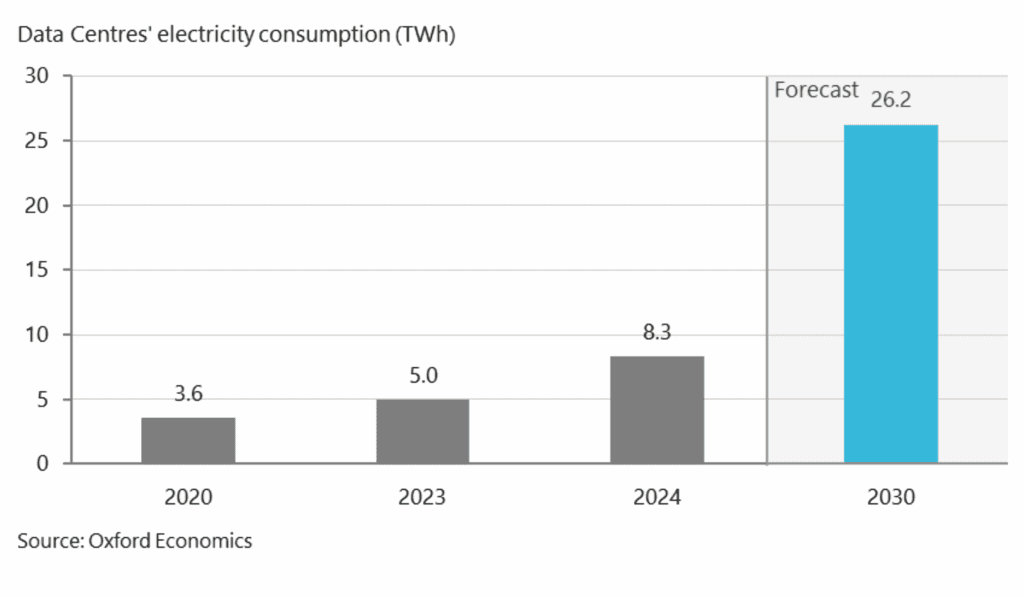
Data centres’ electricity consumption 2020-2030
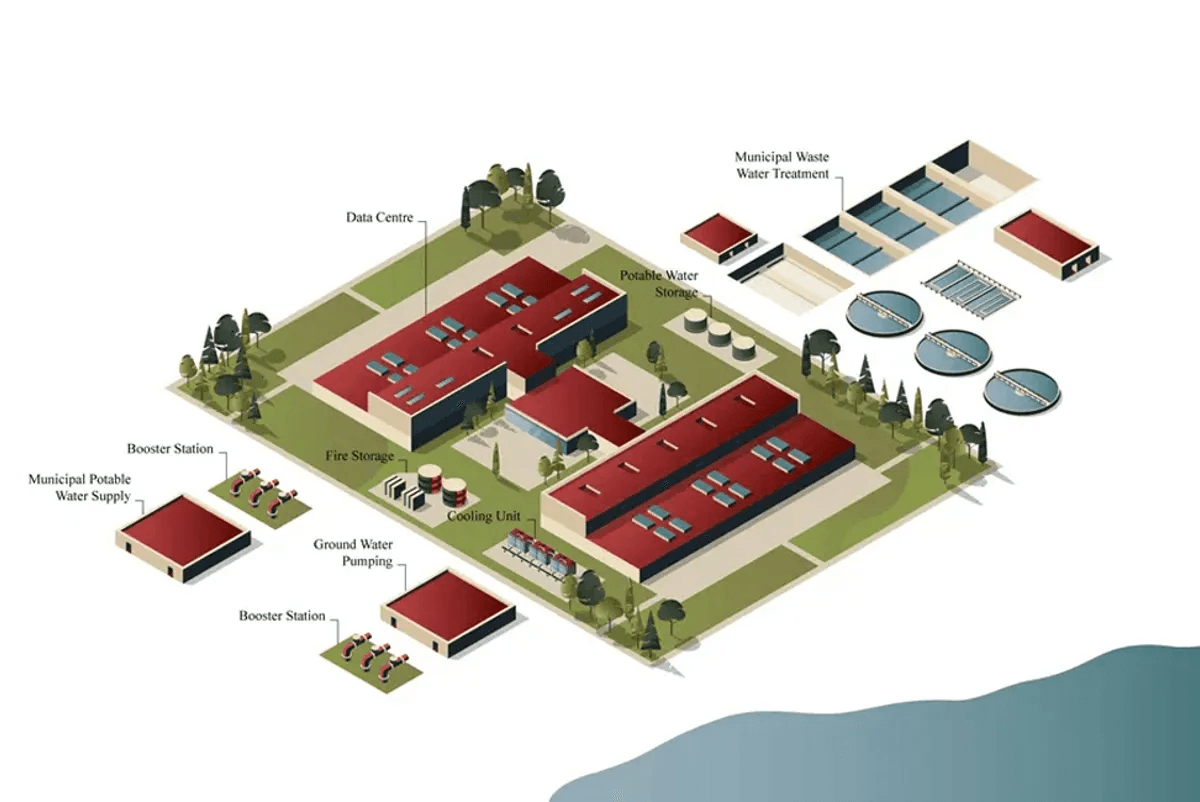
A render of sustainable water management in a data centre as presented by ARUP (2023)